



How Is Property Valuation Done Key Factors That Determine Real Estate Value
Follow Us On:


How Is Property Valuation Done Key Factors That Determine Real Estate Value
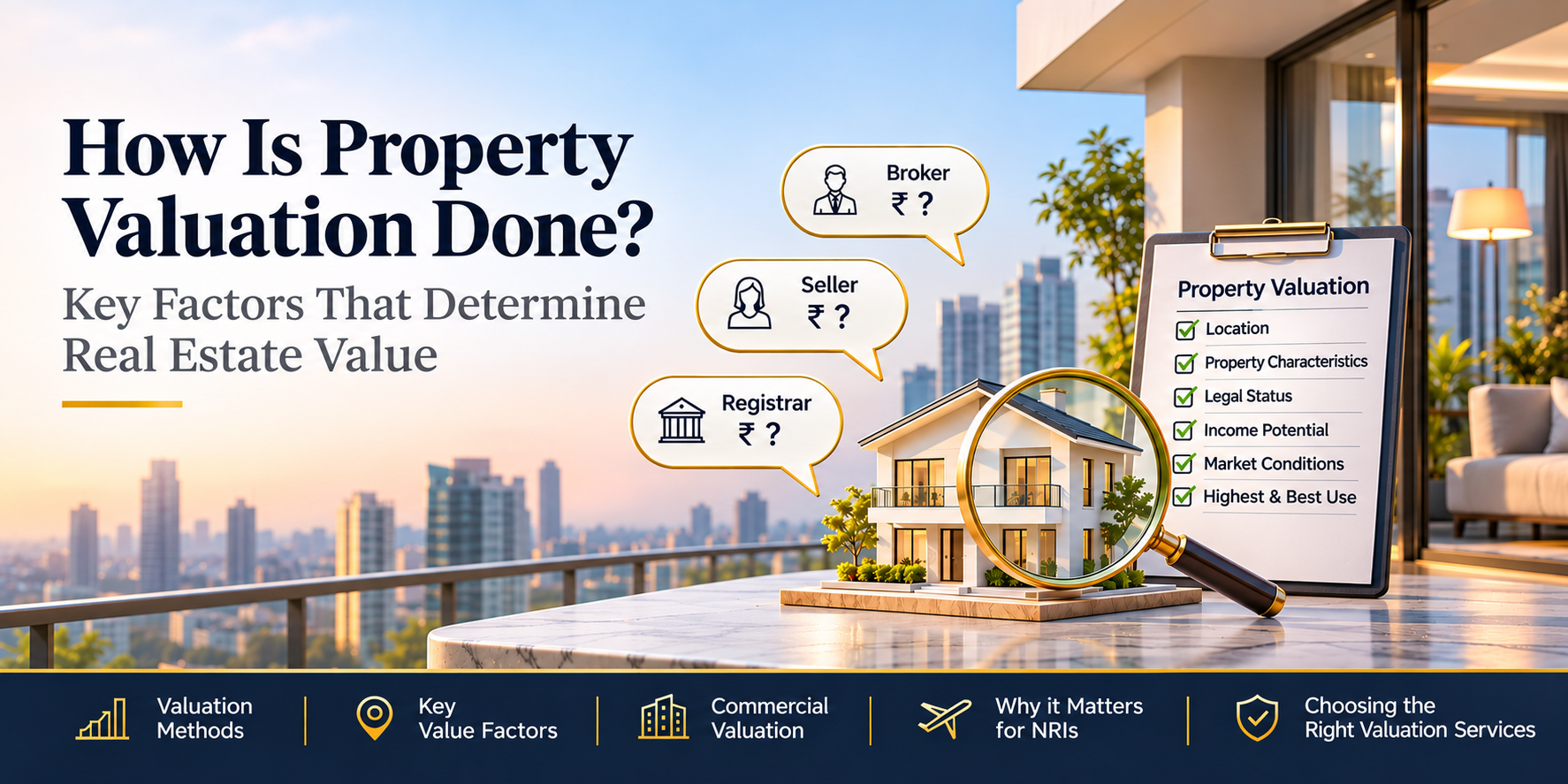
Ask three people what a property is worth and you may get three different answers. The broker quotes what the market seems to want. The seller quotes what they hope for. The registrar's office has its own number. For NRIs managing property from another country, that confusion can be costly. Property valuation is how you replace opinion with evidence. Here is how it works, and what shapes the figure at the end.
What does "market value" actually mean?
The market value of property is the price a willing buyer and a willing seller would reasonably agree on, each acting with knowledge and without pressure, in an open market. It differs from:
• Asking price: what the seller wants, which may or may not be realistic.
• Circle rate or guideline value: the minimum value set by the government for registration and stamp duty. It is a regulatory benchmark, not a measure of market value.
• Distress value: what a property might fetch in a rushed or forced sale.
Knowing which number you are looking at is the first step to a sound decision.
Property valuation methods
Professional real estate valuation typically draws on a few established approaches. The right one depends on the asset type and the purpose of the valuation.
| Method | How it works | Best suited to |
|---|---|---|
| Sales comparison | Compares the property with similar properties recently sold nearby, adjusted for differences | Apartments, houses, plots |
| Income approach | Estimates value from the rental income the property can generate | Offices, retail, rented residential |
| Cost approach | Adds land value to the cost of rebuilding, less depreciation | Newer or specialised buildings |
| Residual / DCF methods | Works back from future value or projected cash flows | Development land and large income assets |
In practice, a valuer often cross-checks more than one method rather than relying on a single number.
Key factors that determine real estate value
• Location and micro-market: Proximity to employment hubs, transport, schools and hospitals matters. So does the character of the specific neighbourhood, not just the city.
• Property characteristics: Size, layout, age, construction quality, floor, view, parking and amenities.
• Condition and maintenance: A well-kept property commands more than one needing heavy repair.
• Legal status: Clear title, approved plans, RERA registration where applicable and complete documentation. Legal gaps can reduce value sharply or stall a sale.
• Income potential: For rented or rentable property, achievable rent, occupancy and lease terms influence value directly.
• Market conditions: Demand and supply, interest rates, local price trends and investor sentiment all play a part.
• Infrastructure and development: Completed or credibly funded projects can lift value. Announcements alone should be weighed with caution.
• Highest and best use: Sometimes a property's value lies in a different use than its current one, such as redevelopment of an underused site.
Commercial property valuation: what's different
Commercial property valuation leans heavily on income. Valuers look at lease length, tenant quality, rent versus market rent, vacancy, operating costs and the yield investors expect for that asset class and location. Two buildings of equal size can differ greatly in value because of their tenants and leases.
Why valuation matters for NRIs
Distance makes an independent view more important. You may need a valuation when you:
• Plan to sell and want a realistic price expectation
• Are buying and want to check the quoted rate against comparables
• Need to understand an inherited or jointly held property
• Are reviewing your portfolio to decide whether to hold, sell or reinvest
• Require a valuation for tax, legal or financing purposes
Relying on a relative's estimate or a single broker's opinion can leave money on the table, or lead to overpaying.
Choosing property valuation services
Look for a valuer with an established methodology, local market data, experience across asset types, and a clear, documented report. Be wary of anyone who offers a number before looking at the property, its documents and recent comparable transactions.
The MCRE view
A valuation is not a formality. It is the foundation for every sound decision about a property: buy, hold, sell or redevelop. MCRE, powered by Adroit Valuation, provides valuation-led advisory for NRIs and HNIs, helping you understand what your property is worth today and what it could be worth with the right strategy.