



What Makes Alibaug a Unique Second-Home Destination
Follow Us On:


What Makes Alibaug a Unique Second-Home Destination
If you have ever stood at the Gateway of India and looked out across the water, you have probably looked straight at Alibaug without quite realizing it. For decades, it was Mumbai's quiet weekend secret, a place where the city's affluent families escaped the chaos for a couple of days, then went right back to forgetting about it until the next long weekend. That's no longer the case. Alibaug has quietly, steadily, turned into one of the most sought-after second-home markets in the country, and the reasons behind that shift are worth understanding before everyone else catches on.
It is a Rare Geographical Double Act
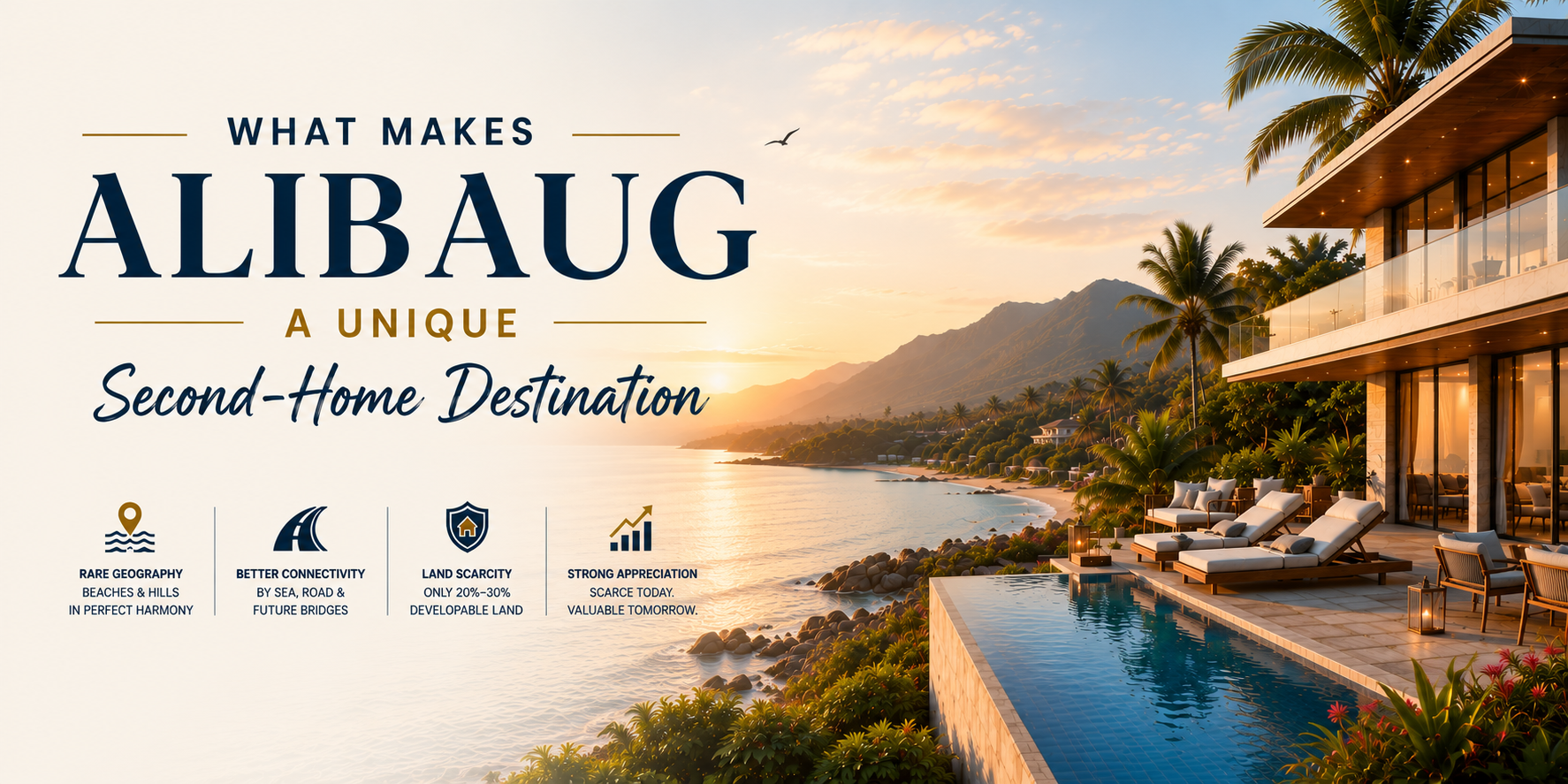
What sets Alibaug apart, more than anything else, is something you can't manufacture: its geography. Sitting in the Konkan belt just south of Mumbai, it's blessed with a long, open western coastline and, on its eastern flank, the gentle rise of the Sahyadri foothills. That's a genuinely unusual combination. Most destinations give you either the beach or the hills, rarely both within the same stretch of land. The result is a landscape that stays green, breathes easier, and feels worlds away from Mumbai's density, even though it's technically right next door.
No Longer Just a Getaway, it is Now Part of Mumbai's Growth Story
Here's the part most people miss. Since 2019, Alibaug hasn't just been a weekend destination, it's been formally folded into the extended Mumbai Metropolitan Region (MMR) planning zone. That single administrative shift changes the entire conversation. When a region moves from "nice place to visit" to "part of the city's long-term blueprint," real estate dynamics shift with it.
Getting There Has Never Been Easier
Accessibility used to be Alibaug's biggest drawback. Not anymore.
• By sea: Speedboats from the Gateway of India get you to Mandwa in as little as 15–30 minutes. If you're driving down, the Ro-Ro ferry carries your vehicle across in 60–90 minutes.
• By road: The Mumbai Trans Harbour Link — Atal Setu — has cut the road journey down to roughly 1–1.5 hours, turning what used to be a half-day trip into a quick commute.
• What's coming next: The proposed Revas–Karanja Bridge is expected to bring travel time from Uran to Alibaug down from 2 hours to just 30 minutes, tightening the loop even further.
Put simply, Alibaug is becoming Mumbai's most accessible coastal escape, and every new piece of infrastructure adds another reason for buyers to take it seriously.
Scarcity That Actually Protects Value
There's a quieter force at work here too: land scarcity, and a fairly deliberate kind of it. Only about 20% to 30% of Alibaug's total land is realistically developable. The rest is shielded by Coastal Regulation Zone (CRZ) rules, mangrove buffers, and agricultural zoning restrictions, making it precious natural habitat. It sounds like a constraint, but it's also exactly what keeps Alibaug from turning into another overbuilt, characterless suburb. That artificial ceiling on supply is a big part of why land values here have kept climbing, and why the exclusivity feels earned rather than manufactured.
From Private Retreat to Income-Generating Asset
Perhaps the most interesting shift in Alibaug's story is how ownership itself has evolved. It used to be simple: you bought a villa, you used it a few weekends a year, and it sat empty the rest of the time. That model is fading. In its place is a hybrid one, where the same villa is both a private family retreat and a professionally managed short-stay asset.
Luxury boutique hospitality brands and managed villa operators have moved in, and the numbers back up why owners are excited:
• Premium villas are seeing occupancy rates of 60% to 80%
• Nightly rates typically range from ₹25,000 to over ₹60,000, depending on location, branding, and features like private pools or beachfront access
• The combination translates into an estimated 12% rental yield for premium villas — a figure that holds fairly consistently across both 4 BHK and 5 BHK configurations
• On top of that yield, the market is pricing in roughly 5% annual appreciation in rental rates
Weekend getaways, destination weddings, corporate offsites — Airbnb-style platforms and professional operators have turned all of it into a genuine income stream, not just an occasional perk of ownership.
Why HNIs Keep Choosing Alibaug Over the Alternatives
Mumbai's high-net-worth buyers have plenty of weekend-home options — Lonavla and Karjat among them — but Alibaug keeps winning the comparison. It's the combination of privacy, wellness-oriented living, and an experiential lifestyle that's genuinely hard to replicate in more inland, more urbanized markets. When you stack that against Alibaug's rental yield potential — which sits firmly in the "high" bracket compared to the "moderate to high" range typical of Lonavla, Khandala, and Karjat — the appeal becomes even clearer.
The Bigger Picture
Alibaug's rise isn't a fluke of good marketing or a passing trend. It's the product of geography that can't be replicated, infrastructure that keeps improving, land scarcity that protects value, and a hospitality ecosystem that's matured enough to turn second homes into serious assets. For Mumbai's HNIs, it's no longer a choice between "second home" and "investment", Alibaug lets them have both.